
Good times for mutual fund investors are continuing.
Investors must invest in a manner appropriate to their age, income stream, return expectations and risk appetite.
If you firmly believe that all things must come to an end, then the decline in equity markets this week should come as no surprise.
Investors should restructure their portfolios and dispose of investments that are not in tune with their risk-appetite.
With all the euphoria in the equity markets, there seems to be a mad rush to invest in diversified equity funds.
The market was all set for another positive opening today and one of the major triggers was the successful Maruti IPO that gave PSU stocks the desired push.
The sentiment remained cautiously optimistic on the premise that a quick and successful war could herald the end of a protracted period of economic and financial uncertainty.
Mutual fund investors had much reason to cheer as equity markets posted one of the strongest weekly gains in the recent past. \n\n
Investors must resist the temptation to get invested with a view to rake in quick profits and should instead utilise the opportunity to book a part of their profits and restructure their portfolios.
Rajiv Mehta, senior analyst with India Infoline, a large brokerage house said his firm has immediately stopped covering Satyam and many other brokerage houses are also expected to do the same.

The market direction will be guided by corporate earnings, especially the oil & gas companies, since they were responsible for earnings disappointment in the past quarter as well.

All the sectoral indices, led by realty, metal, consumer durables and power were trading in the negative zone on Thursday.

A fall presents an opportunity to buy rate-sensitive stocks.
After making its entry into the Bombay Stock Exchange's benchmark 30-share index Sensex in May

The Nifty and Bank Nifty ended at record closing high of 7,913 and 15,865 respectively.
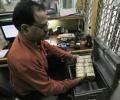
Banking shares are down up to 11% after the Reserve Bank of India has increased the policy repo rate by 25 basis points from 7.25% to 7.5% with immediate effect.

Asian shares have begun the week on a plaintive note.
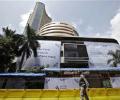
Capital goods, IT, auto and pharmaceuticals lead gains for the financial year

'In the next one-and-a-half, two months you'll get decent amount of opportunities in the mid-cap and small-cap sector at lower levels.'
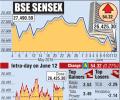
Oil, banks eneded the day in green while few in auto sector lost heavily.

Experts say the BSE Sensex could rise to around 32,000 in a year.
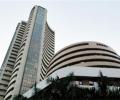
Market breadth on the BSE ended firm as 1,908 shares advanced and 1,156 shares declined

The rupee had retreated from three-week high and ended six paise down at 60.67 against the dollar on demand from importers for the US currency in Thursday's trade.

Sensex witnessed the biggest single day gain since May 2009 in absolute terms.

Similarly, the wide-based 50-issue CNX Nifty of the NSE jumped 109.30 points, or 1.46 per cent, to end above 7,500-mark for the first time at 7,583.40.

Investors booked profits after strong 641-point rally in the previous two sessions, brokers said.

This weakness is likely to continue in the near-term.

Benchmark share indices gained for the fifth straight session on Thursday led by index heavyweight Reliance Industries.

On the gaining side, Hero Moto, SBI, HDFC, HUL and L&T have gained between 1-1.4 per cent.

If investors still have appetite to buy shares in one of the region's most expensive markets, Coal India might stack up.

Some of Modi's biggest reforms have met with fierce political opposition.

Metal stocks fell on Tuesday, with the S&P BSE metal index sliding 2.8 per cent compared to the 0.64 per cent fall in the benchmark S&P BSE Sensex

Markets ended in red; index heavyweight under pressure.

Analysts say that the focus now shifts to global events

Softening rural consumption and the likelihood of weak corporate earnings in the March quarter saw investors dump stocks.

Companies shipping to Europe to see rupee revenues coming under pressure.

In 2014, the benchmark Sensex rose by 6,328.74 points or 30 per cent and recorded a record high of 28,822.37 on November 28.
 © 2026 Rediff.com - Advertise with us - Disclaimer - Privacy Policy - Sitemap - Feedback - About us - Terms of use - Grievances